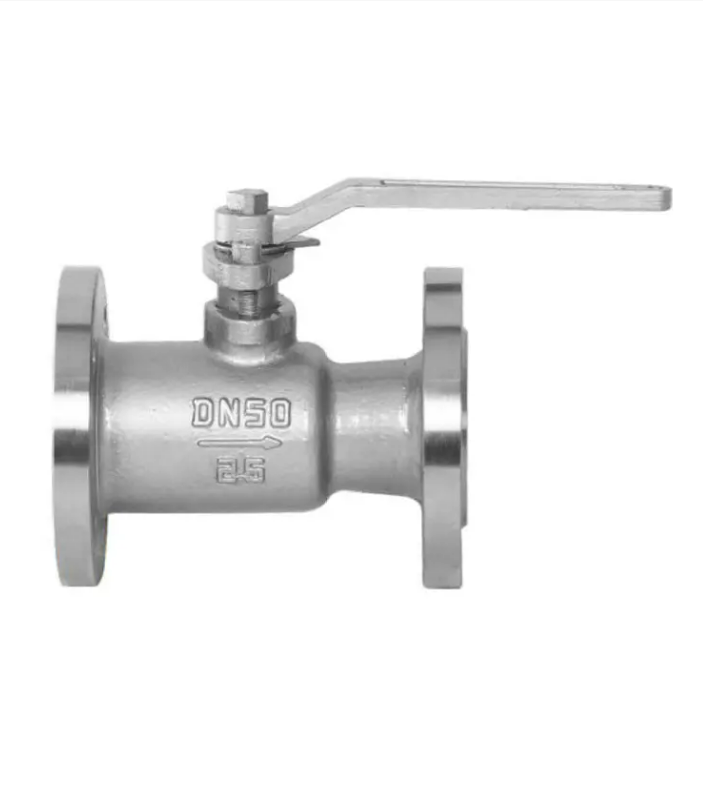
One Piece High Temperature Flanged Ball Valve With Integral Forged Body
 | One Piece High Temperature Flanged Ball Valve With Integral Forged Body
|
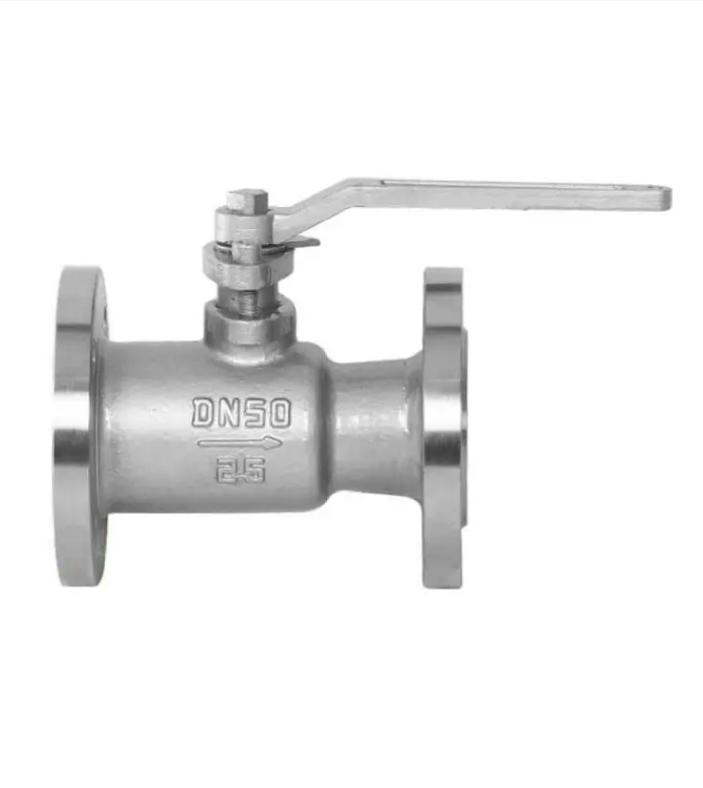
One Piece High Temperature Flanged Ball Valve With Integral Forged Body:
Structural Advantages of Integral One-Piece Valve Body
Split two-piece or three-piece flanged ball valves, which rely on split body gaskets to block medium leakage, are highly prone to gasket thermal creep deformation under long-cycle service of 300℃ saturated high-temperature steam; one-piece high-temperature ball valves, however, feature zero split joint seams on the valve body, eliminating split-plane leakage hazards fundamentally. Forged as a single integral unit with uniform wall thickness and superior overall rigidity, the valve body avoids micro deformation under alternating shock of PN4.0 high pressure and peak 300℃ temperature, a performance merit long validated by abundant on-site maintenance records from frequently cycling boiler steam branch pipelines.
Adopted Industrial Standards & Pressure Performance Parameters
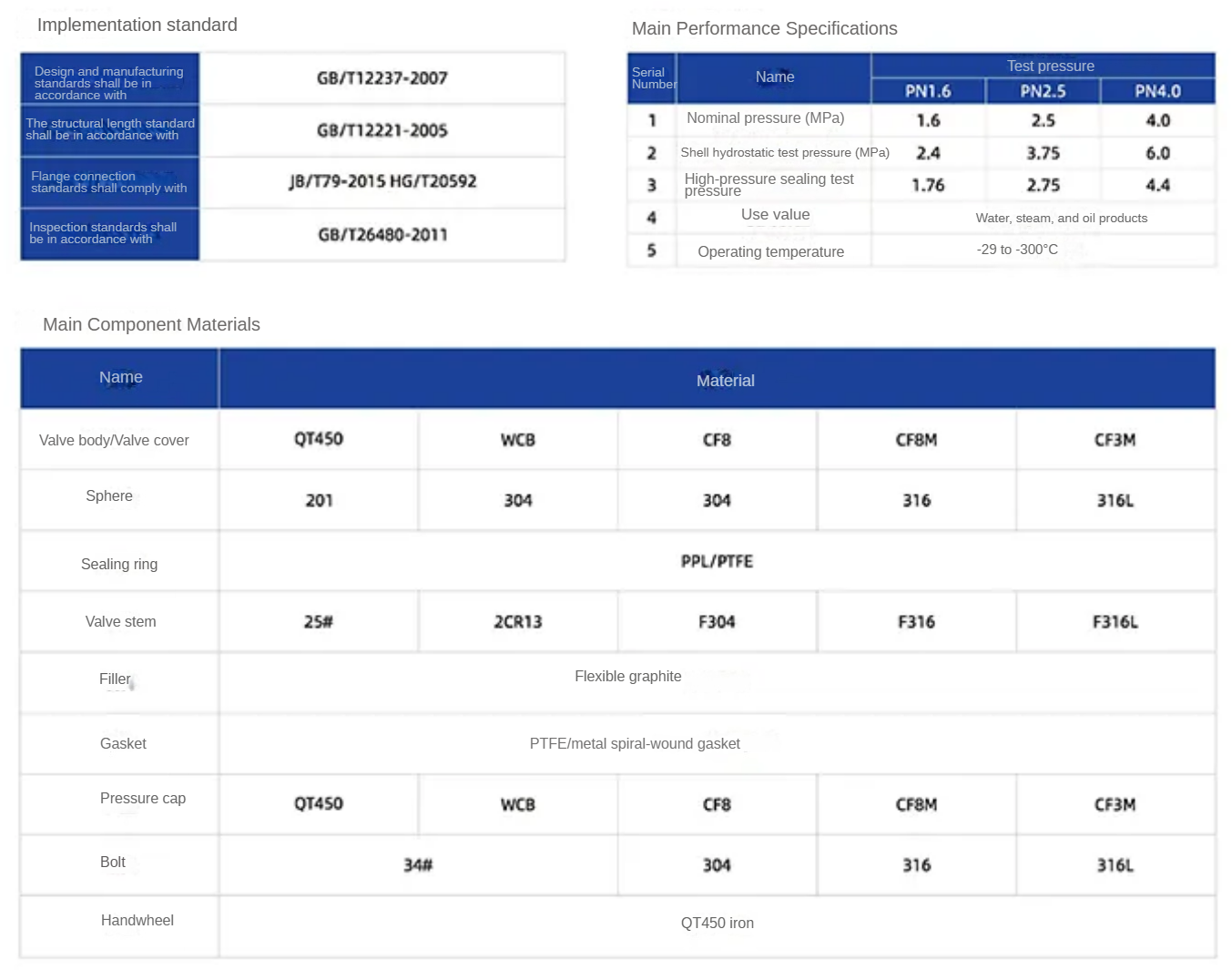
Every procedure covering design, machining, flange matching and factory hydrostatic test of this integral high-temperature flanged ball valve strictly complies with national standards for industrial steel ball valves: design and fabrication abide by GB/T12237-2007, face-to-face structural length follows GB/T12221-2005, flange dimensions are compatible with dual mainstream standards JB/T79-2015 and HG/T20592, while shell and seat tightness inspection uniformly adopts GB/T26480-2011. Full sets of standard certification documents can be furnished for overseas EPC tender submission and cross-border customs file review.
Standardized pressure tiers cover three widely adopted industrial grades PN1.6, PN2.5 and PN4.0, with fixed matching values for shell strength test pressure and high-pressure seat tightness test pressure set by national codes. The peak service temperature of 300℃ is achieved via modified PPL filled sealing rings; compatible media include water, saturated steam and all types of industrial fuel oils, while low-temperature operation can reach -29℃, without rapid hardening or failure of sealing rings during alternating hot and cold fluid delivery.
Complete Optional Component Material Matrix
For valve body and gland cover, multiple material options including QT450 ductile iron, WCB carbon steel, CF8(304), CF8M(316) and CF3M(316L) stainless steel are available to cater to three working scenarios: ambient clean water, medium-temperature steam, and high-temperature mildly corrosive chemical fluid. Solid balls are supplied in 201, 304, 316 and 316L stainless steel; valve stems range from 25# carbon steel and 2CR13 stainless steel to forged F304, F316, F316L stainless steel. Flexible graphite, high-temperature resistant, serves as stem packing, while gaskets can be PTFE flat sheets or metal spiral wound gaskets. All fasteners can be upgraded to 304 or 316 stainless steel to drastically cut bolt oxidation rust risk under high-temp oil and gas service.
Dimensional Drawing Markings & Flange Installation Specifications
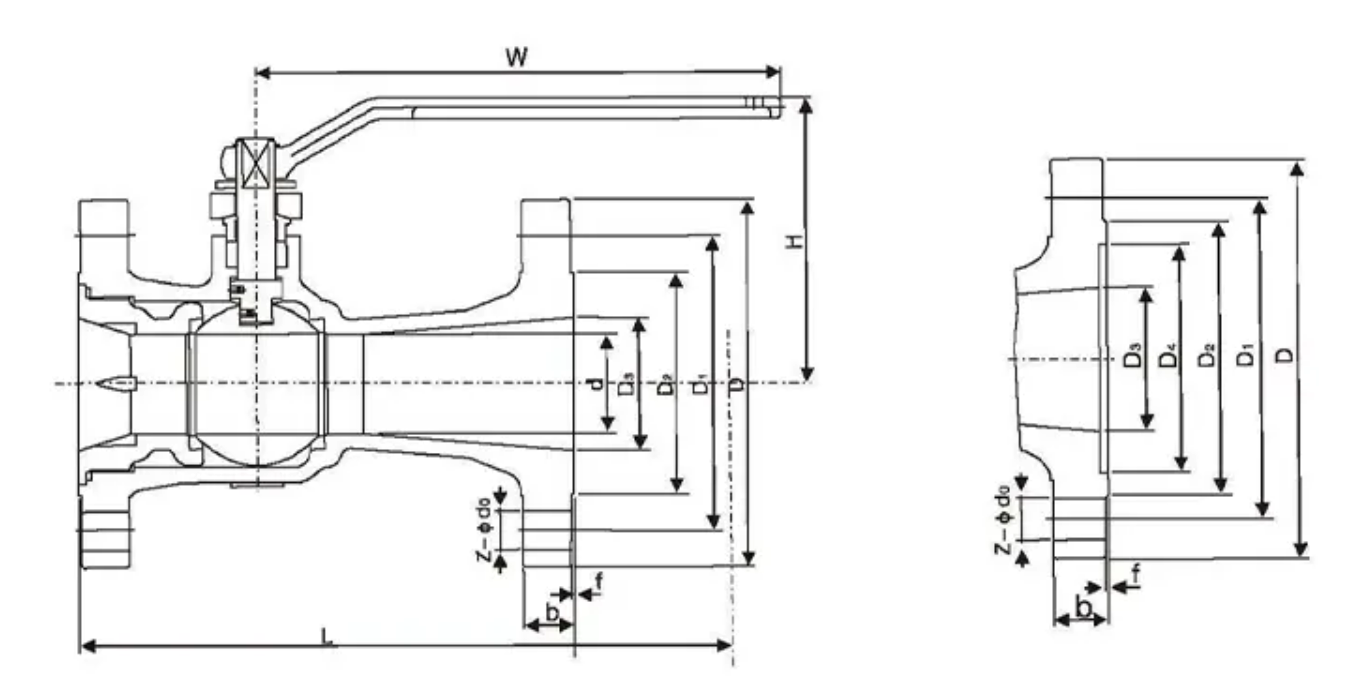
All dimension markings on technical drawings adopt metric millimetre units: L stands for overall face-to-face length between two flanged ends, D refers to maximum outer flange diameter, D1 to D4 sequentially represent flange bolt circle diameter, sealing boss diameter, transition bore diameter and internal flow bore diameter, Z-Φd denotes bolt quantity and single bolt hole diameter, b means flange thickness and f stands for sealing boss height. H indicates total vertical height of the full valve assembly, W is the full extended length of manual operating lever; the lever arm of large bore PN40 variants is lengthened and optimized, enabling smooth 90-degree open-close operation by a single operator without auxiliary tools.
Applicable Working Conditions & On-Site Matching Logic
For all closed pipelines transporting long-cycle high-temperature saturated steam, heat transfer oil and hot fuel oil, integral high-temperature flanged ball valves deliver irreplaceable matching performance, with boiler heating branch lines, thermal oil circulating heating systems and mini refinery oil delivery pipelines as core applied scenarios. Compared with split ball valves, integral units eliminate regular split gasket replacement, slashing annual equipment maintenance consumable cost by over 40%, and noticeably cutting shutdown overhaul frequency for thermal plants running 24/7 non-stop. It should be noted that PTFE sealing inserts can not sustain service above 260℃, and PPL high-temperature sealing assemblies must be selected for peak 300℃ operating conditions.